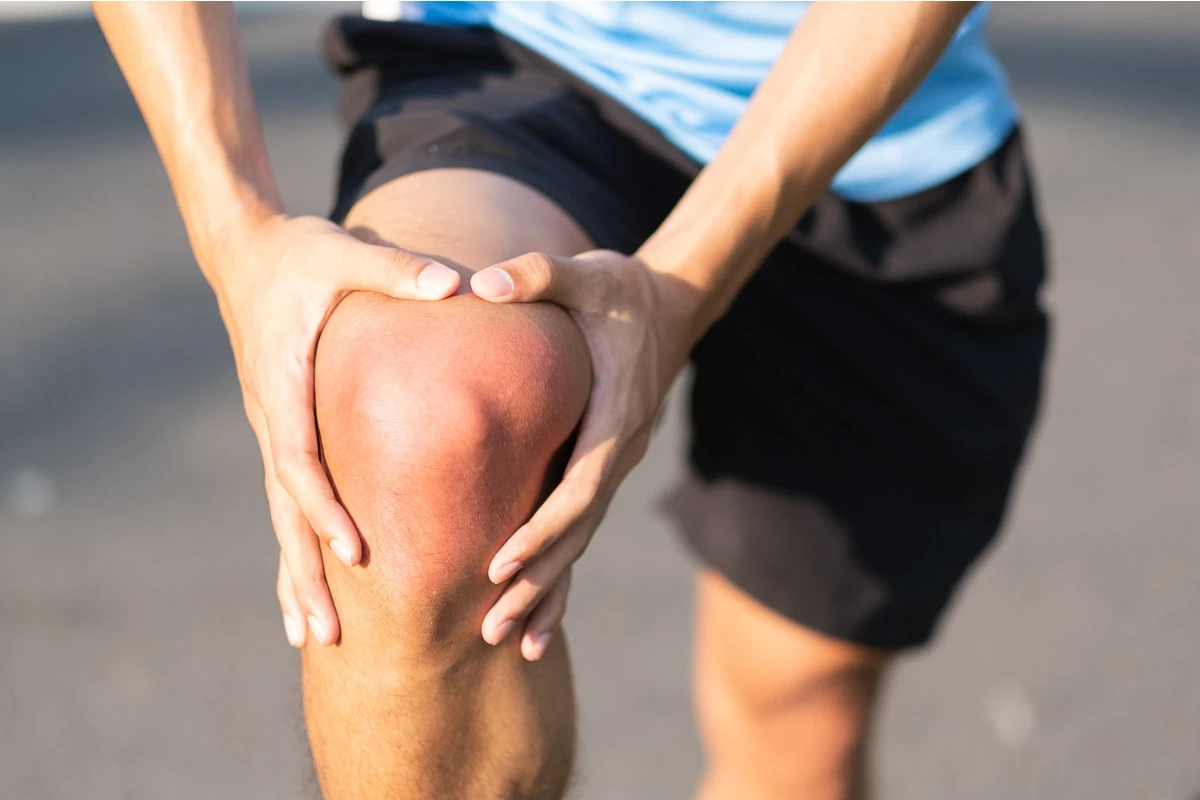
Being told you have “cartilage damage” can sound alarmingly final.
Patients often hear the word cartilage and immediately picture arthritis, a worn-out knee, and joint replacement somewhere down the road.
That is not always the story.
Cartilage damage comes in different forms. A small, isolated defect in an otherwise healthy knee is very different from widespread arthritis affecting much of the joint. The treatment should be different too.
Dr. Tracye Lawyer is a board-certified, fellowship-trained orthopaedic sports medicine surgeon in Boise with a particular focus on cartilage preservation and restoration. Her approach starts with a simple question: what can we reasonably preserve?
Sometimes the answer is rehabilitation and smarter loading. Sometimes another structure, such as the meniscus or ACL, needs attention to protect the cartilage. In selected patients, cartilage-restoration procedures can be considered.
The important part is understanding what kind of cartilage problem you actually have.
What is knee cartilage, and why does it matter?
Inside the knee, the ends of the bones are covered by articular cartilage.
Healthy articular cartilage is smooth and slippery. It allows the bones to move against one another with very little friction while helping the joint manage the forces created by walking, running, jumping and everyday movement.
You rarely think about it when it is working well.
When cartilage is damaged, the knee may begin to feel different.
Patients often describe:
- Deep knee pain
- Swelling after activity
- Catching or grinding
- Stiffness
- Difficulty with impact activities
- Pain when squatting or climbing stairs
- A feeling that the knee simply does not move as smoothly as it used to
Those symptoms are not unique to cartilage damage. Meniscus tears, arthritis, tendon problems and other knee conditions can feel similar.
That is why the diagnosis matters.
Can knee cartilage actually heal?
This is where the answer needs a little nuance.
Articular cartilage has very limited ability to repair itself because it does not have the same blood supply that many other tissues do.
A cut in your skin can heal.
A strained muscle usually heals.
A focal injury to articular cartilage is much less good at repairing itself.
That does not mean nothing can be done.
Cartilage preservation and restoration are about creating the best environment for the joint, protecting the healthy cartilage that remains, and, in selected cases, repairing or replacing a damaged area.
The phrase “cartilage restoration” can sound almost magical.
It is not.
There is no single injection or procedure that simply grows a brand-new knee.
The treatment depends on the size and location of the damage, the condition of the surrounding cartilage, the underlying bone, knee alignment, ligament stability, meniscus health, age, activity goals and whether arthritis is already widespread.
That is a much more useful conversation than asking whether cartilage can “grow back.”
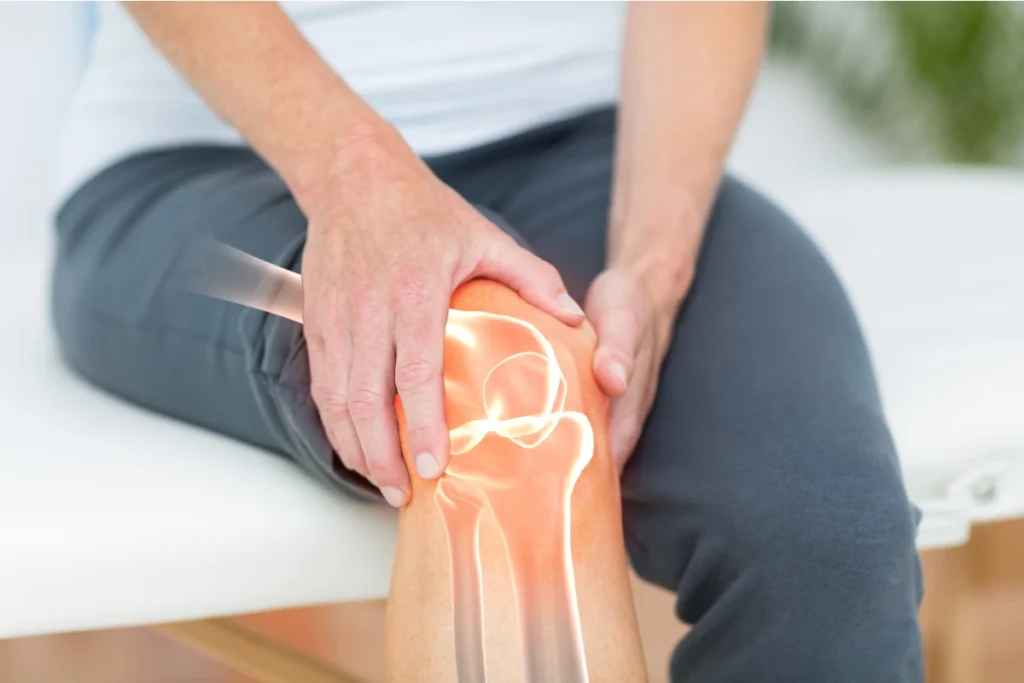
A cartilage defect is not the same as arthritis
This distinction is one of the most important things to understand.
Imagine the smooth road surface inside the knee.
A focal cartilage defect is more like a pothole. One defined area is damaged while much of the surrounding road is still in good condition.
Osteoarthritis is different. The road surface itself is becoming worn across a much larger area.
Cartilage restoration tends to make the most sense when there is a specific, treatable defect in an otherwise reasonably healthy joint.
If cartilage loss is widespread and the joint has advanced arthritis, trying to repair one small section may not solve the bigger problem.
That does not automatically mean joint replacement either.
It means we need to be realistic about what the treatment is trying to achieve.
Dr. Lawyer discusses this distinction in more detail on her Cartilage Preservation & Restoration service page.
How does cartilage damage happen?
Sometimes there is a clear injury.
An athlete lands awkwardly, twists the knee or takes a hard impact. A piece of cartilage may be damaged along with the underlying bone.
Other injuries develop indirectly.
An unstable ACL can allow abnormal movement through the knee.
A damaged or missing meniscus changes how force is distributed through the joint.
Poor alignment can overload one part of the knee year after year.
Sometimes cartilage damage develops gradually without one memorable event.
This is why cartilage preservation is rarely just about the cartilage.
The surgeon needs to ask why that area became damaged in the first place.
If you restore cartilage but ignore an unstable ligament, damaged meniscus or major alignment problem, the new repair may continue taking the same excessive load.
That is fixing the pothole while leaving the truck driving over it every morning.
Why the meniscus matters so much
The meniscus and cartilage have a close relationship.
Each knee has two menisci that sit between the thigh bone and shin bone. They help distribute force, absorb load and contribute to joint stability.
When healthy meniscus tissue is lost, more force can be transferred to the articular cartilage.
This is one reason modern knee surgery places so much value on saving the meniscus whenever possible.
A younger patient who tears a repairable meniscus may benefit from repair rather than simply removing damaged tissue.
For patients who have already lost much of a meniscus and develop persistent pain, meniscal transplantation may be considered in carefully selected cases.
Dr. Lawyer has a specific clinical focus in this area and explains the options on her Meniscal Repair & Allograft Transplantation page.
Cartilage preservation sometimes begins by protecting everything around the cartilage.
What does the ACL have to do with cartilage?
Quite a lot.
The ACL helps control movement and rotation within the knee.
When it is torn, some patients experience repeated episodes of instability. The knee shifts or gives way unexpectedly.
Those episodes can place the meniscus and cartilage at further risk.
For an athlete who wants to return to pivoting sport, restoring stability may be part of protecting the joint long term.
This is why an ACL consultation should not focus only on replacing the ligament.
We look at the meniscus.
We look at cartilage.
We look at alignment, strength and what the patient plans to do with the knee after recovery.
You can learn more about Dr. Lawyer’s approach to ACL repair and reconstruction.
The goal is a stable knee that functions well, not simply a technically reconstructed ACL.
How do we know if cartilage is damaged?
The process usually starts with your story.
Where is the pain?
Did something happen?
Does the knee swell after activity?
Can you run but not squat?
Does it catch?
How long does swelling last?
What have you stopped doing because of it?
A physical examination then looks at motion, stability, tenderness, alignment and how the knee behaves under load.
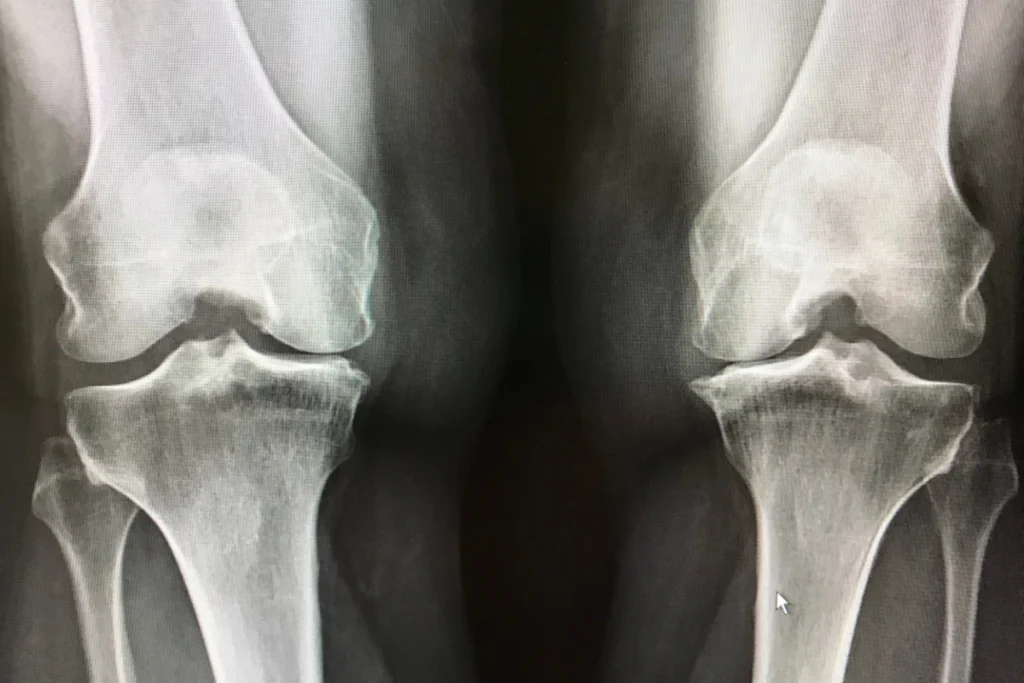
X-rays are useful for assessing joint space, alignment and signs of arthritis.
MRI can show cartilage, meniscus, ligaments and the underlying bone in greater detail. It is particularly helpful when we suspect a focal cartilage lesion that cannot be seen clearly on a standard X-ray.
But once again, imaging is only part of the story.
A beautiful MRI is not the goal.
A knee that behaves better in real life is.
What can be tried before cartilage surgery?
Quite a lot, depending on the problem.
If symptoms are manageable and the knee is mechanically stable, treatment may begin without surgery.
Physical therapy
Good rehabilitation builds the muscles that help control load through the knee.
Quadriceps strength matters.
So do the hips, hamstrings and trunk.
Movement quality can change how force reaches the joint.
Load modification
This does not necessarily mean giving up the activities you love.
Sometimes it means temporarily reducing high-impact volume while strength and control improve.
A runner might use cycling or swimming during part of rehabilitation.
An athlete might reduce jumping volume for a period.
The aim is often to keep you active while giving the joint a better environment.
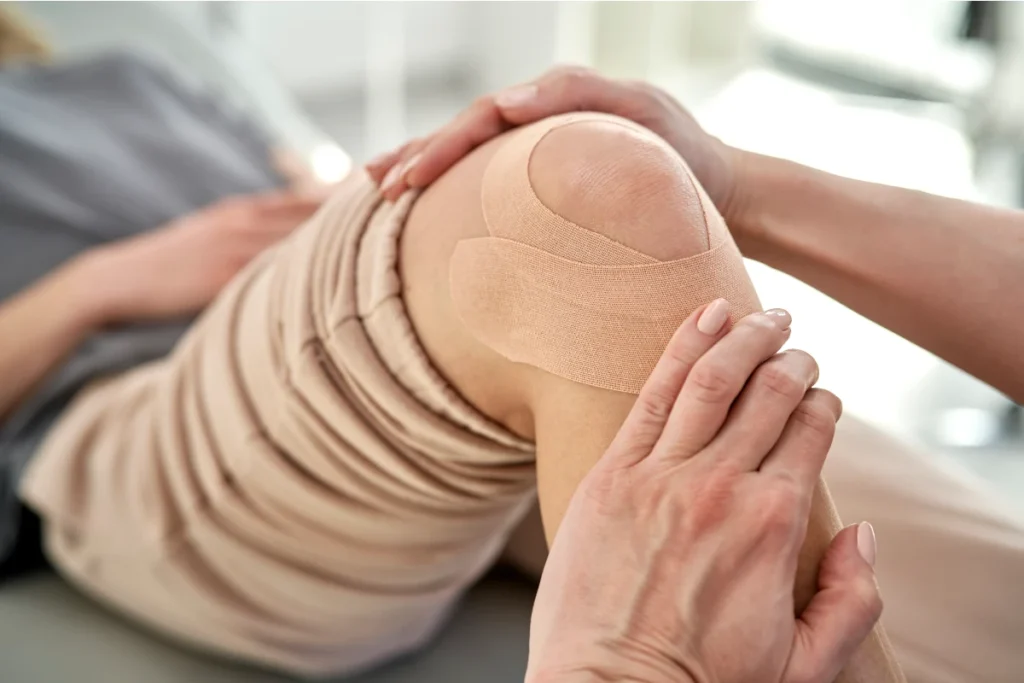
Bracing or taping
Some patients benefit from support designed to change how load passes through a particular part of the knee.
Whether this helps depends on the location of the problem and the patient’s anatomy.
Injections
Injections can have a role in selected patients, particularly when pain or inflammation is making rehabilitation difficult.
Dr. Lawyer also provides platelet-rich plasma, or PRP, injections for appropriate conditions.
PRP deserves realistic expectations.
It may help pain and function in certain situations. Current evidence does not support the idea that a PRP injection can simply regrow an entire missing cartilage surface.
If somebody promises to rebuild your knee with one syringe, it is reasonable to ask some uncomfortable questions.
What are the main cartilage restoration procedures?
This is where treatment becomes very individual.
Different procedures solve different problems.
Chondroplasty
During arthroscopy, unstable or roughened cartilage may sometimes be smoothed.
This is not growing new cartilage.
Think of it more as tidying an unstable damaged edge that is irritating the joint.
For the right problem, it can improve mechanical symptoms.
Marrow stimulation
Procedures such as microfracture create small channels in the bone beneath the damaged cartilage.
The idea is to stimulate a healing response from the bone marrow.
This can produce repair tissue over the defect.
It is not identical to the original articular cartilage, and patient selection matters.
OATS
Osteochondral autograft transfer, usually shortened to OATS, moves a small plug of healthy cartilage and underlying bone from a lower-demand area of the patient’s own joint into a focal defect.
It is a bit like moving a healthy piece of turf into a damaged patch.
The technique is typically considered for particular sizes and locations of cartilage injury.
Osteochondral allograft transplantation
For larger defects, cartilage and underlying bone from donor tissue may sometimes be used.
This allows the surgeon to replace both the damaged cartilage surface and affected bone beneath it.
Again, this is not appropriate for every arthritic knee.
It is a joint-preservation procedure for selected defects.
MACI
MACI stands for matrix-induced autologous chondrocyte implantation.
This is a cell-based cartilage procedure performed in stages.
Cartilage cells are collected from the patient, expanded and later implanted into the defect on a specialised matrix.
Because biological repair takes time, the rehabilitation is carefully staged.
BioCartilage and other adjuncts
BioCartilage and other biologic or scaffold-based technologies may be used as part of selected cartilage procedures.
Their role depends on the defect, procedure and overall condition of the joint.
Dr. Lawyer has trained in and teaches advanced cartilage techniques including MACI, OATS and BioCartilage.
The technology is interesting.
The decision about who actually benefits from it is more important.
Who is a good candidate for cartilage restoration?
There is no perfect age or activity level that automatically qualifies someone.
In general, cartilage-preservation procedures tend to be more relevant when a patient has:
- A focal cartilage defect rather than widespread end-stage arthritis
- Persistent symptoms that match the location of the defect
- A desire to remain active
- Reasonable joint alignment or an alignment problem that can be addressed
- Stable ligaments or instability that can be corrected
- Enough healthy meniscus to protect the joint, or a plan to address meniscus deficiency
- Realistic expectations about rehabilitation
Someone in their thirties with one traumatic cartilage defect is a very different patient from someone in their seventies with advanced arthritis throughout the knee.
Both deserve treatment.
They may simply need different treatment.
Is cartilage restoration an alternative to knee replacement?
Sometimes.
But that sentence needs careful handling.
Cartilage restoration can help selected patients preserve their natural joint and may delay the need for joint replacement.
That is quite different from promising that it will prevent a knee replacement forever.
No responsible surgeon can promise that.
The best candidate is often somebody with limited damage in an otherwise healthy or salvageable joint.
Once arthritis becomes widespread, the conversation changes.
The aim is always to choose the operation that fits the knee you have, not the operation that sounds most appealing on a website.
For a broader look at how these treatments fit into orthopaedic care, Dr. Lawyer works as a partner at Catalyst Orthopaedics & Sports Medicine, where cartilage preservation forms part of a wider program covering sports medicine, knee surgery, injections and minimally invasive orthopaedic care.
Catalyst also has a dedicated guide to cartilage preservation and the range of surgical and non-surgical strategies used to protect joint health.
What does recovery from cartilage surgery look like?
This is not usually the surgery where you feel great at three weeks and decide rehabilitation is finished.
Cartilage needs time.
The exact recovery depends enormously on the procedure.
A small arthroscopic chondroplasty and a cell-based MACI procedure are not comparable recoveries.
Some cartilage procedures require several weeks of restricted or modified weight-bearing.
Range of motion is progressed according to the location and type of repair.
Strength comes back gradually.
Running, jumping and cutting arrive later.
For many patients, the overall return to higher-level activity is measured in months.
That can be frustrating for active people.
Dr. Lawyer understands that part particularly well.
She competed as a Stanford athlete and at an elite level herself. Wanting to get back quickly is normal.
But cartilage biology does not care how much you miss your sport.
Good rehabilitation respects healing first, then gradually exposes the repair to the loads it will eventually need to tolerate.
Patience is not inactivity.
It is part of the treatment.
A fairly typical cartilage conversation
Imagine a 34-year-old recreational soccer player.
She injured her knee two years ago.
The ligament healed well and she returned to sport, but something never felt quite right.
Now the knee swells after games.
Running in a straight line is manageable, but deep squats and stairs can produce sharp pain.
X-rays look fairly reassuring.
An MRI shows a focal cartilage defect on part of the femoral condyle.
This is exactly where the phrase “cartilage damage” needs context.
How large is the defect?
Is the underlying bone involved?
What is the condition of the surrounding cartilage?
Is the meniscus healthy?
Is the knee aligned well?
Is the ACL stable?
What has already been tried?
The answer might still be rehabilitation.
It might be a cartilage procedure.
It might be treatment of another problem contributing to the overload.
The MRI identifies the pothole.
The consultation works out why it is there and whether fixing it will actually improve the road.
Why Dr. Lawyer’s background matters here
Cartilage preservation is not simply another procedure on Dr. Lawyer’s service list.
It has been a substantial part of her academic and clinical work.
She holds both an MD and PhD and has a particular professional focus on cartilage regeneration, preservation and sports medicine.
She has trained in advanced cartilage techniques and teaches these approaches to other orthopaedic surgeons.
That background matters because cartilage treatment is rarely a one-procedure decision.
The surgeon needs to understand the biology, the mechanics of the joint, associated ligament or meniscus injuries, and the patient’s long-term goals.
Sometimes the most sophisticated decision is to operate.
Sometimes it is knowing that an impressive-sounding procedure will not solve the actual problem.
When should you have knee cartilage damage evaluated?
Consider an orthopaedic evaluation if:
- Your knee repeatedly swells after activity
- You have persistent deep joint pain
- Catching or mechanical symptoms keep returning
- You were told an MRI shows a cartilage defect
- Your symptoms have not improved with rehabilitation
- You have had previous meniscus or ACL surgery and the knee is becoming painful again
- You are young or active and have been told you already have “arthritis”
- You want to understand whether joint-preservation options exist before considering replacement
The appointment is not a commitment to surgery.
It is a chance to understand what part of the joint is damaged and what choices are realistic.

Can your knee be preserved?
Sometimes, yes.
Not every cartilage defect can be restored.
Not every arthritic knee can be preserved indefinitely.
But “cartilage damage” is not a treatment plan.
The useful questions are more specific:
How much cartilage is damaged?
Where is it?
Why did it happen?
What does the rest of the knee look like?
What do you want this knee to do for the next ten or twenty years?
Those answers are where cartilage preservation begins.
If you have persistent knee pain, swelling or a known cartilage injury, you can schedule an evaluation with Dr. Tracye Lawyer in Boise to discuss whether non-surgical care, cartilage restoration or another joint-preservation strategy fits your situation.
For independent patient information on the principles and procedures involved, the American Academy of Orthopaedic Surgeons provides a detailed guide to articular cartilage restoration.
Dr Lawyer sees patients at Catalyst Orthopaedics & Sports Medicine in Boise, caring for people from across the Treasure Valley and the greater Mountain West.
You can request an appointment here:
Appointments with Dr Tracye Lawyer
You’re not committing to surgery—you’re committing to a clear explanation, a plan that fits your goals, and a path forward that makes sense.
FAQs
Can damaged knee cartilage grow back on its own?
Articular cartilage has very limited ability to heal itself. Small areas of damage do not behave like a cut in the skin or a muscle strain. Treatment may focus on reducing symptoms and protecting the joint, while cartilage-restoration procedures may be considered for selected focal defects.
Does cartilage damage mean I have arthritis?
No. A focal cartilage defect affects a specific area of the joint. Osteoarthritis usually involves broader degeneration of the joint surface. The distinction is important because treatment options can be very different.
Can cartilage restoration prevent a knee replacement?
Cartilage restoration may help preserve a joint and potentially delay the need for replacement in selected patients. It cannot guarantee that a patient will never need a knee replacement in the future.
What is the best procedure for damaged knee cartilage?
There is no single best procedure. Options such as chondroplasty, marrow stimulation, OATS, osteochondral allograft and MACI address different types of cartilage problems. The size and location of the defect, bone involvement, meniscus health, alignment, age and activity goals all affect the decision.
Can PRP regrow knee cartilage?
PRP may help pain and function in selected patients, but current evidence does not support describing PRP as a way to regrow an entire missing cartilage surface. It may form part of a broader treatment plan when appropriate.
Why does the meniscus matter if I have cartilage damage?
The meniscus helps distribute load across the knee and protects articular cartilage. Loss of meniscus tissue can increase stress on the joint surface, which is why preserving or restoring meniscus function may be part of a cartilage-preservation strategy.
How long is recovery after cartilage restoration surgery?
Recovery varies considerably by procedure. Some patients return to activity within a few months, while larger grafting or cell-based procedures require a longer staged rehabilitation. Weight-bearing, motion, strengthening and return to sport are progressed according to the specific repair.