
When to See an Orthopaedic Sports Surgeon

  • Articles

If joint or sports-related pain is hanging around, changing how you move, or keeping you from the things you love, it’s reasonable to talk with an orthopaedic sports surgeon—especially one who understands both cartilage preservation and the demands of your sport.

What an orthopaedic sports surgeon actually does

Orthopaedic surgeons specialise in bones, joints, ligaments, tendons, muscles, and nerves. A sports-focused orthopaedic surgeon adds extra training in athletic injuries and safe return to sport.

Dr Tracye Lawyer, MD, PhD, FAAOS is:

  • Board-certified in Orthopaedic Surgery and fellowship-trained in orthopaedic sports medicine
  • A surgeon whose practice focuses on:
    • Cartilage preservation and restoration
    • ACL and meniscus surgery
    • Rotator cuff repair
    • Total and reverse shoulder replacement
    • Platelet-rich plasma (PRP) injections for select joint and tendon problems

Her day-to-day work is not “all surgery, all the time.” It’s diagnosis first, then choosing between:

  • Targeted rehabilitation
  • Activity and workload changes
  • Image-guided injections (including PRP in selected cases)
  • Arthroscopic or open surgery only when the structure truly needs to be fixed

Red-flag situations: Don’t wait, get urgent care

Some problems should not wait for a routine clinic visit. You should seek urgent or emergency care (ER, urgent care, or 911) if you have:

  • A suspected broken bone, especially if:
    • The bone looks out of place
    • The skin is open over the fracture
  • A joint that suddenly looks deformed or “out of socket”
  • Inability to take even a few steps on an injured leg
  • Severe pain with rapid swelling after an injury
  • A very hot, red, swollen joint with fever or chills
  • Loss of feeling or sudden weakness after a fall or collision

Emergency teams can stabilise you first. Once you’re safe, ongoing care often transitions to an orthopaedic specialist like Dr Lawyer.
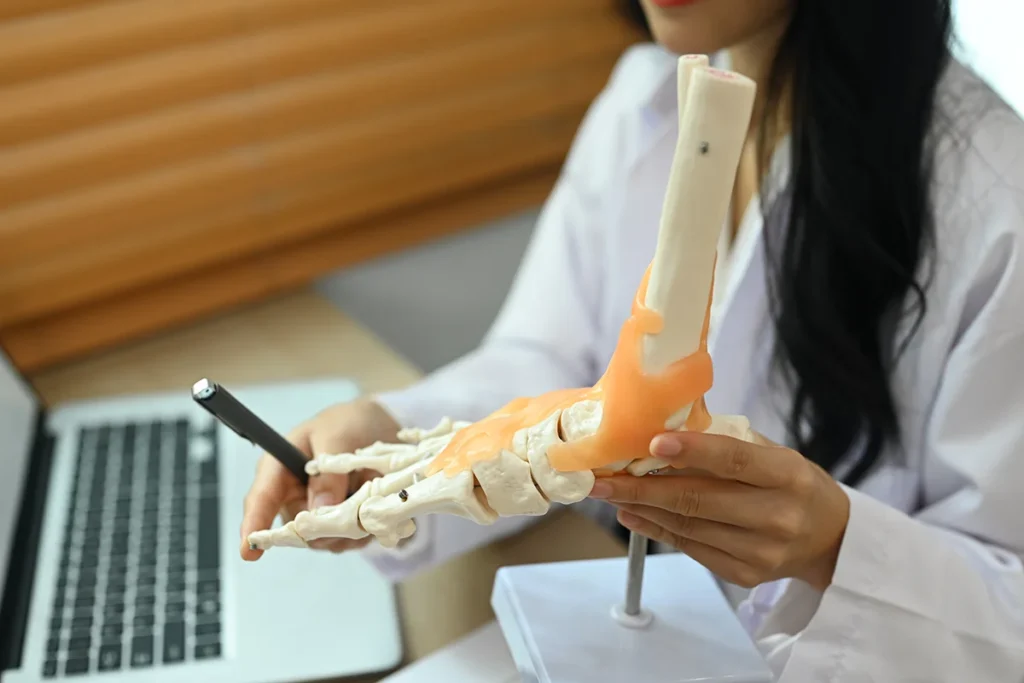
Doctor showing ankle skeleton highlighting when to see an orthopaedic sports surgeon

Everyday signs it’s time to see an orthopaedic surgeon

You don’t need a dramatic accident to “earn” a visit. The American Academy of Orthopaedic Surgeons suggests it’s perfectly reasonable to see an orthopaedic surgeon if you have:

  • Pain (constant or off-and-on) that lasts more than 3 months
  • Limited range of motion in a joint
  • Symptoms that limit daily function—walking, stairs, work, or hobbies
  • Difficulty standing, walking, or moving around
  • An injury that isn’t improving with simple measures like rest, ice, and over-the-counter pain relief

It also makes sense to book with an orthopaedic sports surgeon when:

  • You’re unsure whether you’re looking at a sprain or a tear
  • Pain is waking you up at night
  • You’ve already tried basic physio or “home exercise” and you’re still stuck
  • Another clinician has mentioned surgery and you’d like a second opinion

Seeing a surgeon does not automatically mean you’re signing up for an operation. It means you’re getting clarity and options.

How Dr Lawyer’s sports background helps active patients

Before medicine, Tracye Lawyer was an elite multi-sport athlete:

  • NCAA heptathlon champion and three-time All-American at Stanford
  • Three-time Pac-10 heptathlon champion and member of the Stanford Athletics Hall of Fame
  • Pac-10 Player of the Year in women’s soccer
  • Competed at the U.S. Olympic Trials in track and field

That experience shapes how she cares for athletes and active adults in Boise:

  • She understands seasons, training cycles, and real-world schedules
  • She knows the pressure to “get back out there”—and when that’s a bad idea
  • She uses objective criteria (strength, movement quality, sport-specific tests), not just the calendar, to clear you for return to play

If you’re curious about her athletic career, her Wikipedia biography gives a nice overview of her track and soccer days.

Region-by-region: When to ask for help (with Dr Lawyer’s specialties in mind)

Shoulder: Rotator cuff, labrum, and arthritis

Book a shoulder evaluation if you notice:

  • Pain that’s worse at night or when you lie on that side
  • Weakness lifting the arm or reaching overhead
  • A sense of catching, clicking, or the shoulder “slipping”
  • A fall or dislocation followed by ongoing instability or loss of trust in the joint

These patterns can point toward rotator cuff tears, impingement, labral tears, or arthritis, all areas where Dr Lawyer performs arthroscopic repairs and shoulder replacement when needed.

Knee: ACL, meniscus, and cartilage

Consider seeing Dr Lawyer for your knee if:

  • You felt or heard a “pop,” followed by swelling and instability
  • The knee locks, catches, or gives way on stairs or turns
  • Pain and stiffness make it hard to walk any real distance
  • You’re a cutting, pivoting, or jumping athlete who can’t trust the knee

These problems often involve ACL tears, meniscus tears, or cartilage damage—Dr Lawyer’s core surgical focus alongside cartilage preservation strategies that aim to protect the joint long-term.

Elbow: Throwing and weight-bearing problems

For the elbow, a sports-oriented consult is sensible if you have:

  • Pain with throwing, serving, or repeated lifting
  • Loss of velocity or accuracy you can’t explain
  • Locking, catching, or decreased ability to fully straighten the arm

As part of her sports medicine practice, Dr Lawyer treats ligament, tendon, and cartilage injuries around the elbow, especially in throwers and strength athletes.

Cartilage and joint preservation

You may not know you have a cartilage problem until someone shows it to you on imaging. But there are clues:

  • Joint pain that’s deep, mechanical, and worse with impact loading
  • Swelling after activity, even if X-rays look “not too bad”
  • A history of meniscus or ligament injury that never fully settled

Dr Lawyer’s PhD work focused on cartilage regeneration, and her clinical practice includes cartilage restoration and joint preservation techniques in the knee, shoulder, and elbow.

For younger and middle-aged patients, seeing a cartilage-focused surgeon early can sometimes mean smaller procedures now instead of joint replacement later.

“Wait and see” vs early specialist input

There’s a healthy middle ground between “ignore it” and “rush to surgery.”

When a short trial of self-care makes sense

For mild, clearly overuse-related aches (new workout, weekend yard project), it’s reasonable to try:

  • A few days of relative rest
  • Ice or heat
  • Short-term over-the-counter pain relief (if safe for you)
  • Gentle stretching and low-impact movement

If things are trending better over 1–2 weeks, you can keep going and gradually ramp back up.

When it’s safer to get eyes on it

Move sooner toward an orthopaedic visit if:

  • Pain is not improving or is getting worse after 1–2 weeks
  • You’ve had repeated flare-ups of the same problem
  • You’re modifying your sport so much it doesn’t feel like the same sport anymore
  • You’re worried about doing more damage by “pushing through”

The AAOS specifically notes that pain lasting more than 3 months, limited motion, or difficulty with daily activities are all good reasons to see an orthopaedic surgeon.

Tracye Lawyer MD

What to expect at a visit with Dr Tracye Lawyer

A first appointment is about listening, testing, and planning—not pushing you into a procedure.

You can expect:

  1. Conversation first
    • When your symptoms started
    • What you’ve already tried
    • What you need your body to do—workday, family duties, and sport
  2. Targeted exam
    • How the joint moves
    • Strength, stability, and specific sports tests
    • Checking nearby joints and muscles so nothing is missed
  3. Imaging when needed
    • X-rays for bone and joint spaces
    • Ultrasound or MRI when tendons, ligaments, or cartilage are the main concern
  4. A diagnosis-first plan
    • Clear explanation of what’s going on in plain language
    • Options that may include rehab, load management, injections (including PRP in select cases), or surgery if the structure truly needs repair

Her goal is to match the plan to your goals and risk tolerance—not a one-size-fits-all protocol.

Getting ready for your appointment

A little preparation can make your visit smoother and more useful. The AAOS recommends:

  • Arrive a few minutes early for forms and X-rays
  • Bring:
    • Prior imaging and reports (X-ray, MRI, CT)
    • A list of medications and supplements
    • A short written timeline of your symptoms
  • Wear clothing that lets the shoulder, knee, or elbow be examined easily
  • Jot down your top 3 questions so we cover what matters most to you

You’re encouraged to ask questions until the plan makes sense—including the “what if we don’t do anything?” version.

Trusted external resource

For a general, evidence-based overview of what orthopaedic surgeons do and when to see one, the American Academy of Orthopaedic Surgeons’ OrthoInfo article on Orthopaedic Surgeons is an excellent starting point.

How to schedule with Dr Tracye Lawyer in Boise

Dr Lawyer sees patients at Catalyst Orthopaedics & Sports Medicine in Boise, caring for people from across the Treasure Valley and the greater Mountain West.

You can request an appointment here:
Appointments with Dr Tracye Lawyer

You’re not committing to surgery—you’re committing to a clear explanation, a plan that fits your goals, and a path forward that makes sense.

FAQs: When to see an orthopaedic sports surgeon

Do I have to be an athlete to see Dr Lawyer?
No. Many of her patients are recreationally active or simply want to walk, work, and sleep without pain. Her sports background helps, but the goal is the same: get you back to the activities that matter to you.

If I see a surgeon, is surgery my only option?
Not at all. Many patients at Dr Lawyer’s practice are treated with tailored rehab, load management, and targeted injections. Surgery is reserved for problems that truly require structural repair or reconstruction.

How long should I live with joint pain before I see someone?
If pain has lasted more than 3 months, is waking you up, or is changing how you move through your day, it’s reasonable to book an appointment. You don’t have to wait until you “can’t take it anymore.”

Can I still play my sport while we’re figuring this out?
Sometimes yes, sometimes no. Dr Lawyer will look at the type of injury, your season, and your long-term risk. In some cases, she’ll help you modify training so you can stay active without making the problem worse.

What if I’ve been told I “need surgery” and I’m not sure?
Second opinions are very common. Dr Lawyer frequently sees patients who want to confirm a recommendation, understand alternatives, or clarify timing around work and sport.

  • When to See an Orthopaedic Sports Surgeon

    If joint or sports-related pain is hanging around, changing how you move, or keeping you from the things you love, it’s reasonable to talk with an orthopaedic sports surgeon—especially one who understands both cartilage preservation and the demands of your sport.

    What an orthopaedic sports surgeon actually does

    Orthopaedic surgeons specialise in bones, joints, ligaments, tendons, muscles, and nerves. A sports-focused orthopaedic surgeon adds extra training in athletic injuries and safe return to sport.

    Dr Tracye Lawyer, MD, PhD, FAAOS is:

    • Board-certified in Orthopaedic Surgery and fellowship-trained in orthopaedic sports medicine
    • A surgeon whose practice focuses on:
      • Cartilage preservation and restoration
      • ACL and meniscus surgery
      • Rotator cuff repair
      • Total and reverse shoulder replacement
      • Platelet-rich plasma (PRP) injections for select joint and tendon problems

    Her day-to-day work is not “all surgery, all the time.” It’s diagnosis first, then choosing between:

    • Targeted rehabilitation
    • Activity and workload changes
    • Image-guided injections (including PRP in selected cases)
    • Arthroscopic or open surgery only when the structure truly needs to be fixed

    Red-flag situations: Don’t wait, get urgent care

    Some problems should not wait for a routine clinic visit. You should seek urgent or emergency care (ER, urgent care, or 911) if you have:

    • A suspected broken bone, especially if:
      • The bone looks out of place
      • The skin is open over the fracture
    • A joint that suddenly looks deformed or “out of socket”
    • Inability to take even a few steps on an injured leg
    • Severe pain with rapid swelling after an injury
    • A very hot, red, swollen joint with fever or chills
    • Loss of feeling or sudden weakness after a fall or collision

    Emergency teams can stabilise you first. Once you’re safe, ongoing care often transitions to an orthopaedic specialist like Dr Lawyer.

    Doctor showing ankle skeleton highlighting when to see an orthopaedic sports surgeon

    Everyday signs it’s time to see an orthopaedic surgeon

    You don’t need a dramatic accident to “earn” a visit. The American Academy of Orthopaedic Surgeons suggests it’s perfectly reasonable to see an orthopaedic surgeon if you have:

    • Pain (constant or off-and-on) that lasts more than 3 months
    • Limited range of motion in a joint
    • Symptoms that limit daily function—walking, stairs, work, or hobbies
    • Difficulty standing, walking, or moving around
    • An injury that isn’t improving with simple measures like rest, ice, and over-the-counter pain relief

    It also makes sense to book with an orthopaedic sports surgeon when:

    • You’re unsure whether you’re looking at a sprain or a tear
    • Pain is waking you up at night
    • You’ve already tried basic physio or “home exercise” and you’re still stuck
    • Another clinician has mentioned surgery and you’d like a second opinion

    Seeing a surgeon does not automatically mean you’re signing up for an operation. It means you’re getting clarity and options.

    How Dr Lawyer’s sports background helps active patients

    Before medicine, Tracye Lawyer was an elite multi-sport athlete:

    • NCAA heptathlon champion and three-time All-American at Stanford
    • Three-time Pac-10 heptathlon champion and member of the Stanford Athletics Hall of Fame
    • Pac-10 Player of the Year in women’s soccer
    • Competed at the U.S. Olympic Trials in track and field

    That experience shapes how she cares for athletes and active adults in Boise:

    • She understands seasons, training cycles, and real-world schedules
    • She knows the pressure to “get back out there”—and when that’s a bad idea
    • She uses objective criteria (strength, movement quality, sport-specific tests), not just the calendar, to clear you for return to play

    If you’re curious about her athletic career, her Wikipedia biography gives a nice overview of her track and soccer days.

    Region-by-region: When to ask for help (with Dr Lawyer’s specialties in mind)

    Shoulder: Rotator cuff, labrum, and arthritis

    Book a shoulder evaluation if you notice:

    • Pain that’s worse at night or when you lie on that side
    • Weakness lifting the arm or reaching overhead
    • A sense of catching, clicking, or the shoulder “slipping”
    • A fall or dislocation followed by ongoing instability or loss of trust in the joint

    These patterns can point toward rotator cuff tears, impingement, labral tears, or arthritis, all areas where Dr Lawyer performs arthroscopic repairs and shoulder replacement when needed.

    Knee: ACL, meniscus, and cartilage

    Consider seeing Dr Lawyer for your knee if:

    • You felt or heard a “pop,” followed by swelling and instability
    • The knee locks, catches, or gives way on stairs or turns
    • Pain and stiffness make it hard to walk any real distance
    • You’re a cutting, pivoting, or jumping athlete who can’t trust the knee

    These problems often involve ACL tears, meniscus tears, or cartilage damage—Dr Lawyer’s core surgical focus alongside cartilage preservation strategies that aim to protect the joint long-term.

    Elbow: Throwing and weight-bearing problems

    For the elbow, a sports-oriented consult is sensible if you have:

    • Pain with throwing, serving, or repeated lifting
    • Loss of velocity or accuracy you can’t explain
    • Locking, catching, or decreased ability to fully straighten the arm

    As part of her sports medicine practice, Dr Lawyer treats ligament, tendon, and cartilage injuries around the elbow, especially in throwers and strength athletes.

    Cartilage and joint preservation

    You may not know you have a cartilage problem until someone shows it to you on imaging. But there are clues:

    • Joint pain that’s deep, mechanical, and worse with impact loading
    • Swelling after activity, even if X-rays look “not too bad”
    • A history of meniscus or ligament injury that never fully settled

    Dr Lawyer’s PhD work focused on cartilage regeneration, and her clinical practice includes cartilage restoration and joint preservation techniques in the knee, shoulder, and elbow.

    For younger and middle-aged patients, seeing a cartilage-focused surgeon early can sometimes mean smaller procedures now instead of joint replacement later.

    “Wait and see” vs early specialist input

    There’s a healthy middle ground between “ignore it” and “rush to surgery.”

    When a short trial of self-care makes sense

    For mild, clearly overuse-related aches (new workout, weekend yard project), it’s reasonable to try:

    • A few days of relative rest
    • Ice or heat
    • Short-term over-the-counter pain relief (if safe for you)
    • Gentle stretching and low-impact movement

    If things are trending better over 1–2 weeks, you can keep going and gradually ramp back up.

    When it’s safer to get eyes on it

    Move sooner toward an orthopaedic visit if:

    • Pain is not improving or is getting worse after 1–2 weeks
    • You’ve had repeated flare-ups of the same problem
    • You’re modifying your sport so much it doesn’t feel like the same sport anymore
    • You’re worried about doing more damage by “pushing through”

    The AAOS specifically notes that pain lasting more than 3 months, limited motion, or difficulty with daily activities are all good reasons to see an orthopaedic surgeon.

    Tracye Lawyer MD

    What to expect at a visit with Dr Tracye Lawyer

    A first appointment is about listening, testing, and planning—not pushing you into a procedure.

    You can expect:

    1. Conversation first
      • When your symptoms started
      • What you’ve already tried
      • What you need your body to do—workday, family duties, and sport
    2. Targeted exam
      • How the joint moves
      • Strength, stability, and specific sports tests
      • Checking nearby joints and muscles so nothing is missed
    3. Imaging when needed
      • X-rays for bone and joint spaces
      • Ultrasound or MRI when tendons, ligaments, or cartilage are the main concern
    4. A diagnosis-first plan
      • Clear explanation of what’s going on in plain language
      • Options that may include rehab, load management, injections (including PRP in select cases), or surgery if the structure truly needs repair

    Her goal is to match the plan to your goals and risk tolerance—not a one-size-fits-all protocol.

    Getting ready for your appointment

    A little preparation can make your visit smoother and more useful. The AAOS recommends:

    • Arrive a few minutes early for forms and X-rays
    • Bring:
      • Prior imaging and reports (X-ray, MRI, CT)
      • A list of medications and supplements
      • A short written timeline of your symptoms
    • Wear clothing that lets the shoulder, knee, or elbow be examined easily
    • Jot down your top 3 questions so we cover what matters most to you

    You’re encouraged to ask questions until the plan makes sense—including the “what if we don’t do anything?” version.

    Trusted external resource

    For a general, evidence-based overview of what orthopaedic surgeons do and when to see one, the American Academy of Orthopaedic Surgeons’ OrthoInfo article on Orthopaedic Surgeons is an excellent starting point.

    How to schedule with Dr Tracye Lawyer in Boise

    Dr Lawyer sees patients at Catalyst Orthopaedics & Sports Medicine in Boise, caring for people from across the Treasure Valley and the greater Mountain West.

    You can request an appointment here:
    Appointments with Dr Tracye Lawyer

    You’re not committing to surgery—you’re committing to a clear explanation, a plan that fits your goals, and a path forward that makes sense.

    FAQs: When to see an orthopaedic sports surgeon

    Do I have to be an athlete to see Dr Lawyer?
    No. Many of her patients are recreationally active or simply want to walk, work, and sleep without pain. Her sports background helps, but the goal is the same: get you back to the activities that matter to you.

    If I see a surgeon, is surgery my only option?
    Not at all. Many patients at Dr Lawyer’s practice are treated with tailored rehab, load management, and targeted injections. Surgery is reserved for problems that truly require structural repair or reconstruction.

    How long should I live with joint pain before I see someone?
    If pain has lasted more than 3 months, is waking you up, or is changing how you move through your day, it’s reasonable to book an appointment. You don’t have to wait until you “can’t take it anymore.”

    Can I still play my sport while we’re figuring this out?
    Sometimes yes, sometimes no. Dr Lawyer will look at the type of injury, your season, and your long-term risk. In some cases, she’ll help you modify training so you can stay active without making the problem worse.

    What if I’ve been told I “need surgery” and I’m not sure?
    Second opinions are very common. Dr Lawyer frequently sees patients who want to confirm a recommendation, understand alternatives, or clarify timing around work and sport.